

Heat Recovery Ventilation: MVHR Installation Designed With Your Heating
A Mitsubishi MVHR system, sized room by room by the same designer building your heating system. From New Mills across Derbyshire’s High Peak, with whole-house design surveys out to Manchester.


Airtight Homes Trap More Than Heat
Ventilation planned after the walls go up is a guess.
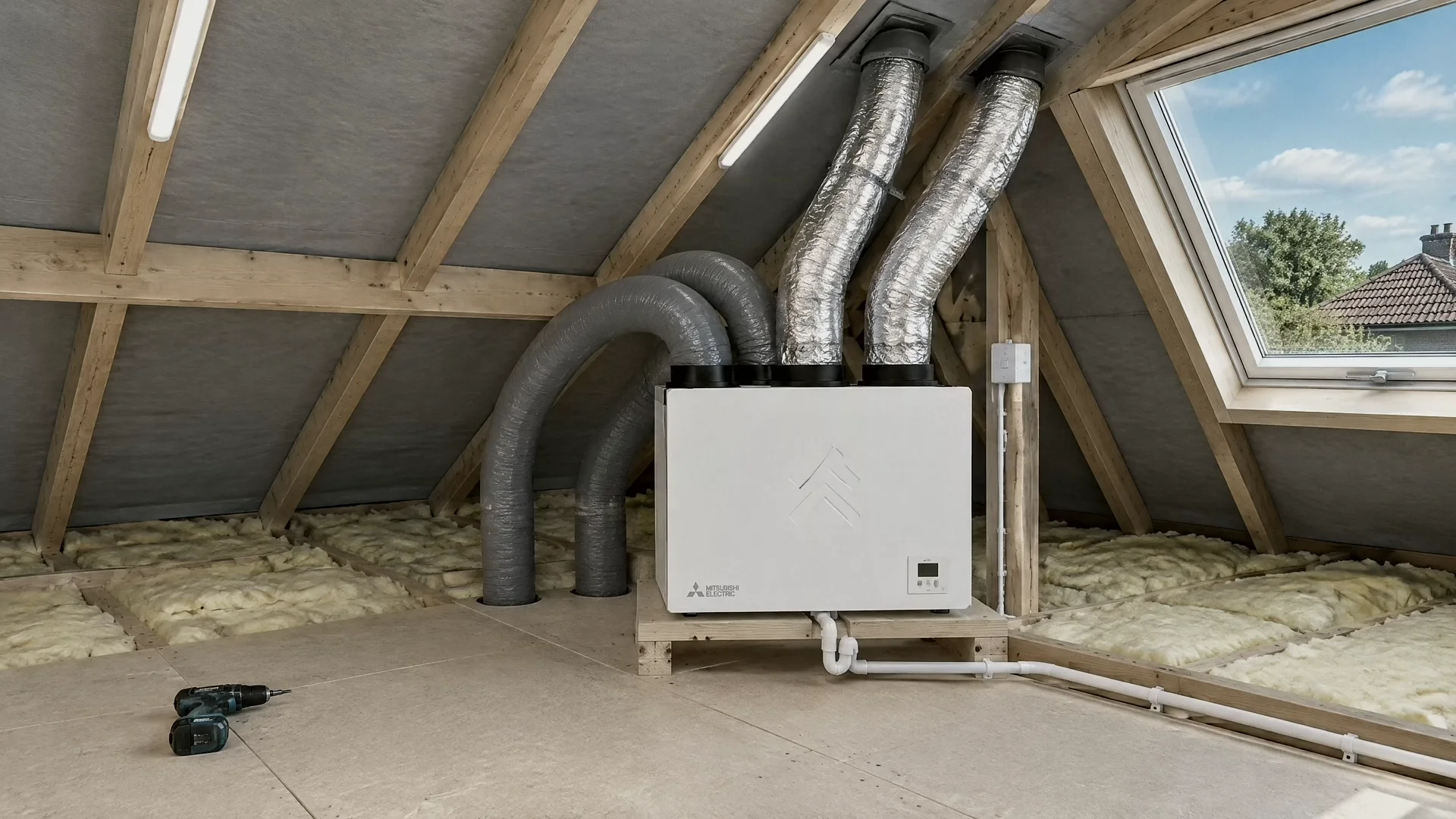
Mechanical ventilation with heat recovery is a whole-house ventilation system that runs air through the rooms on a loop. It pulls stale, damp air out of bathrooms and kitchens and brings fresh air back in filtered, while a heat exchanger keeps most of the warmth.
Airtight renovations, new builds and homes fighting condensation and mould feel the gap first.
- “If the house is airtight, do we still need MVHR?”
Airtightness keeps the warmth in, and the stale air stays in with it. Heat recovery lets the warmth stay while the stale air goes.
We size the ductwork and the airflow room by room, inside the same survey as your heating, before anything goes into the loft.
What Makes Our MVHR Installations Different?
The person designing your heating plans your ventilation too.
-
Airflow assessed room by room before any unit is specified
-
Ventilation designed from the same survey as your heating
-
Mitsubishi MVHR units sized to your house and its heat loss
-
A fixed quote before work starts, survey included

What High Peak Customers Say About Us
Reviews from homes around New Mills, Glossop and Buxton, left by the people who let us in.
Air On A Loop, With The Warmth Kept
The unit holds the core and filters, and two duct runs carry stale air out and fresh air in.
-
Stale Air Leaves The Wet Rooms
Damp air is pulled out of bathrooms and kitchens and carried outside.
- Extract Valve
- Extract Duct
- Exhaust Duct
- Exhaust Terminal
- Stale Air
-
Fresh Air Comes Back Filtered
Outside air comes in through the filters and is supplied to the rooms you live in.
- Intake Terminal
- Intake Duct
- Supply Duct
- Supply Valve
- Fresh Air
-
The Core Keeps The Warmth
Both streams pass through the heat exchanger, so most of the warmth stays inside.
- Heat Exchanger Core
- Fresh Air Filter
- Extract Filter
- Supply Fan
- Extract Fan
-
Sized From The Heating Survey
Ductwork and airflow are sized from the numbers used for your heating, so nothing is measured twice.
- Unit
- End Panel
- Lid
- Controller
What’s Included in Our MVHR Installation
The same survey that measures your heat loss gives you a fixed quote and a fitted system, start to finish.

-
Survey and Measure
We measure the house room by room, airflow needs included, before specifying a unit.
-
Full System Design
We design the ductwork routes, unit sizing and airflow rates alongside your heating system, from one set of drawings.
-
Fixed Quote
We write the unit and the price down together before we order anything.
-
Installation by the Team That Designed It
The team runs the ductwork and sites the unit where the design calls for it.
-
Commissioning and Handover
We prove the airflow rates room by room, walk you through the controls, then set you up with reminders for when the system needs checking.
Mitsubishi MVHR, sized to your house before it’s ordered.
The MVHR Numbers, On Paper
Three figures worth knowing before the survey.
-
1 day
One working day, from your enquiry to hearing back from us
-
3 to 4
Weeks for a retrofit; a new build is 1 to 2 weeks
-
2 years
Guarantee on the install, alongside the manufacturer’s warranty on the unit


“My house is warmer with a heat pump than it was with a boiler”
Hear firsthand from our customer Fraser about how installing a heat pump has transformed his day to day living.
We’ve turned his cold 18th-century end terrace house into a comfortable, efficient home. No more waiting for the boiler to heat up the house in the morning.
Fraser’s property now sits at a consistent 19°C all year round.
MVHR Questions, Answered Without The Jargon

-
Will it make the house draughty?
No. Air moves through ducted vents rather than open windows, so the vents control the flow and keep it away from where you sit.
-
Do I need to keep opening windows for fresh air once it’s fitted?
No, that’s the point of the system. Fresh air comes in filtered on a loop, so windows can stay shut through winter.
-
Will it help with the condensation and mould we’re fighting?
The system pulls damp air out on a constant loop instead of only when a window opens, which is why it suits a home fighting condensation.
-
Will it work with my existing heating, or does it replace it?
It runs alongside whatever heats the house. MVHR moves the air, your heat pump or boiler keeps it warm, and we design the two together.
-
How much does MVHR installation cost?
The design survey gives you the exact figure for your house, and we write it into a fixed quote before we order anything.
Common Questions About MVHR
We prefer to design MVHR inside the whole-system design, because the survey has measured the heat loss, the room volumes and the power for each room, so we size the ventilation to the same numbers as the heating. We look at standalone MVHR case by case: tell us about the house and we’ll say whether it makes sense.
A retrofit takes 3 to 4 weeks, a new build 1 to 2 weeks. The quote states how long the job takes and how much disruption to expect, agreed before we start.
We work out ducting routes, siting and planning rules at the design stage, before we promise you anything.
Our office takes the booking. Your MVHR installers are the same team that designed the system.
Yes. Tell us at the survey and we design both together, so we’re not fitting ductwork around heating pipework that’s already gone in.
A 2-year workmanship guarantee on the install, alongside the manufacturer’s warranty on the Mitsubishi unit.
It needs a check from time to time, like any system with fans and filters. We set up reminders at handover, so you know when it’s due.
Mitsubishi. We size it from your room volumes and heat loss, then order it.
Tell Us About The House
What the job is, where you are, and how to reach you. Our lead engineer picks it up from there.
Reviews From Across The High Peak
One Survey Covers The Air Your Rooms Need
Book your MVHR survey and you hear back within one working day.
